What hormones are involved in carbohydrate metabolism? Chi Tiết
byÝ Nghĩa Của Là Gì ?•
0
Mẹo Hướng dẫn What hormones are involved in carbohydrate metabolism? 2021
Hero đang tìm kiếm từ khóa What hormones are involved in carbohydrate metabolism? 2022-10-04 22:37:35 san sẻ Bí kíp về trong nội dung bài viết một cách 2021.
The various phases of carbohydrate metabolism, namely, the oxidation of sugar to carbon dioxide and water and its conversion to fat, glycogen synthesis, and the new formation of sugar from protein and possibly fat, are all under hormonal control. The importance of the islands of Langerhans, the adrenal medulla, the adrenal cortex, and the thyroid in carbohydrate metabolism are well recognized. Great progress has been made in establishing both the conditions
that determine and the factors that regulate the secretory activity of these organs as well as the exact role of their various hormones in the chain of intermediary reactions involved in carbohydrate metabolism. Recent work has shown that still another endocrine factor must be added to the above list, namely, an anterior pituitary factor other than corticotropin, most probably growth hormone or some other hormone closely linked with it.
Metabolic pathways[edit]
Glycolysis[edit]
Gluconeogenesis[edit]
Glycogenolysis[edit]
Glycogenesis[edit]
Pentose phosphate pathway[edit]
Fructose metabolism[edit]
Galactose metabolism[edit]
Energy
production[edit]
Hormonal
regulation[edit]
Carbohydrates as
storage[edit]
Human diseases[edit]
References[edit]
External links[edit]
What are the 3 hormones control the carbohydrate metabolism?
Which hormones are not involved in carbohydrate metabolism?
Which steroid hormones is involved in carbohydrate metabolism?
Is growth hormone involved in carbohydrate metabolism?
The relation of the anterior pituitary to
carbohydrate metabolism originally
Ad
Ad
Ad
Ad
Ad
Ad
Ad
Ad
Ad
Ad
Ad
Ad
Ad
Ad
Ad
Ad
Ad
Ad
Ad
Ad
Ad
how every hormone controls every
metabolism in our body toàn thân shows that each hormone is important for us and this can be seen in this presentation
Research Scholar, JSS Medical college, JSS AHER
how every hormone controls every metabolism in our body toàn thân shows that each hormone is important for us and this can be seen in this presentation
Carbohydrate metabolism is the whole of the biochemical processes responsible for the metabolic formation, breakdown, and interconversion of
carbohydrates in living organisms.
Carbohydrates are central to many essential metabolic
pathways.[1] Plants synthesize carbohydrates from carbon dioxide and water through
photosynthesis, allowing them to store energy absorbed from sunlight internally.[2] When animals and fungi
consume plants, they use cellular respiration to break down these stored carbohydrates to make energy available to cells.[2] Both animals and plants temporarily store the released energy in the form of high-energy molecules, such as
ATP, for use in various cellular processes.[3]
Humans can consume a variety of carbohydrates, digestion breaks down complex carbohydrates into simple
monomers (monosaccharides): glucose, fructose, mannose and
galactose. After resorption in the gut, the monosaccharides are transported, through the
portal vein, to the liver, where all non-glucose monosacharids (fructose, galactose) are transformed into glucose as well.[4] Glucose (blood sugar) is distributed to cells in the
tissues, where it is broken down via cellular respiration, or stored as
glycogen.[3][4] In cellular (aerobic) respiration, glucose and oxygen
are metabolized to release energy, with carbon dioxide and water as
endproducts.[2][4]
Metabolic pathways[edit]
Overview of connections between metabolic processes.
Glycolysis[edit]
Glycolysis is the process
of breaking down a glucose molecule into two pyruvate molecules, while storing energy released during this process as ATP and
NADH.[2] Nearly all organisms that break down glucose utilize glycolysis.[2] Glucose regulation and product use are the primary categories in which these
pathways differ between organisms.[2] In some tissues and organisms, glycolysis is the sole method of energy production.[2] This pathway is common to both anaerobic and aerobic
respiration.[1]
Glycolysis consists of ten steps, split into two phases.[2] During the first phase, it requires the breakdown of two ATP
molecules.[1] During the second phase, chemical energy from the intermediates is transferred into ATP and NADH.[2] The breakdown of one molecule of glucose results in two molecules of pyruvate, which can be further oxidized to access more
energy in later processes.[1]
Glycolysis can be regulated at different steps of the process through feedback regulation. The step that is regulated the most is the third step. This regulation is to ensure that the body toàn thân is not over-producing pyruvate molecules. The regulation also allows for the storage of glucose molecules into fatty
acids.[5] There are various enzymes that are used throughout glycolysis. The enzymes upregulate, downregulate, and
feedback regulate the process.
Gluconeogenesis[edit]
Gluconeogenesis (GNG) is a metabolic pathway that results in the generation of glucose from certain non-carbohydrate
carbon substrates. It is a ubiquitous process, present in plants, animals, fungi, bacteria, and other microorganisms.[6] In vertebrates, gluconeogenesis occurs mainly in the liver and, to a lesser extent, in the
cortex of the kidneys. It is one of two primary mechanisms – the other being degradation of glycogen (glycogenolysis) – used by humans and
many other animals to maintain blood sugar levels, avoiding low levels (hypoglycemia).[7] In
ruminants, because dietary carbohydrates tend to be metabolized by rumen organisms, gluconeogenesis occurs regardless of fasting, low-carbohydrate diets, exercise, etc.[8] In many other
animals, the process occurs during periods of fasting, starvation, low-carbohydrate diets, or intense exercise.
In
humans, substrates for gluconeogenesis may come from any non-carbohydrate sources that can be converted to pyruvate or intermediates of glycolysis (see figure). For the breakdown of proteins, these substrates include
glucogenic amino acids (although not ketogenic amino acids); from breakdown of lipids (such as
triglycerides), they include glycerol, odd-chain fatty acids (although not even-chain fatty acids, see below); and from other parts of metabolism they include
lactate from the Cori cycle. Under conditions of prolonged fasting, acetone derived from ketone bodies can also serve as a substrate, providing a pathway from fatty acids to glucose.[9] Although most gluconeogenesis occurs in the liver, the relative contribution of gluconeogenesis by the kidney is increased in diabetes and prolonged fasting.[10]
The gluconeogenesis pathway is highly
endergonic until it is coupled to the hydrolysis of ATP or GTP, effectively making the process
exergonic. For example, the pathway leading from pyruvate to glucose-6-phosphate requires 4 molecules of ATP and 2 molecules of GTP to proceed spontaneously. These ATPs are supplied from
fatty acid catabolism via beta oxidation.[11]
Glycogenolysis[edit]
Glycogenolysis refers to the breakdown of
glycogen.[12] In the liver, muscles, and the kidney, this process occurs to provide glucose when necessary.[12] A single glucose molecule is cleaved from a branch of glycogen, and is transformed into
glucose-1-phosphate during this process.[1] This molecule can then be converted to glucose-6-phosphate, an
intermediate in the glycolysis pathway.[1]
Glucose-6-phosphate can then progress through glycolysis.[1] Glycolysis only
requires the input of one molecule of ATP when the glucose originates in glycogen.[1] Alternatively, glucose-6-phosphate can be converted back into glucose in the liver and the kidneys, allowing it to raise blood glucose levels if
necessary.[2]
Glucagon in the liver stimulates glycogenolysis when the blood glucose is lowered, known as hypoglycemia.[12] The glycogen in the
liver can function as a backup source of glucose between meals.[2] Liver glycogen mainly serves the central nervous system. Adrenaline stimulates the breakdown of glycogen in the skeletal muscle during
exercise.[12] In the muscles, glycogen ensures a rapidly accessible energy source for movement.[2]
Glycogenesis[edit]
Glycogenesis refers to the process of synthesizing glycogen.[12] In humans, glucose can be converted to glycogen via this
process.[2] Glycogen is a highly branched structure, consisting of the core protein Glycogenin, surrounded by branches of glucose units, linked
together.[2][12] The branching of glycogen increases its solubility, and allows for a higher number of glucose molecules to be accessible for breakdown at the same
time.[2] Glycogenesis occurs primarily in the liver, skeletal muscles, and kidney.[2] The Glycogenesis pathway consumes energy, like most synthetic pathways, because an ATP and a UTP are consumed for each molecule of glucose
introduced.[13]
Pentose phosphate pathway[edit]
The
pentose phosphate pathway is an alternative method of oxidizing glucose.[12] It occurs in the liver,
adipose tissue, adrenal cortex, testis, mammary glands, phagocytes, and red blood cells.[12] It produces products that are used in other cell processes, while reducing NADP to
NADPH.[12][14] This pathway is regulated through changes in the activity of glucose-6-phosphate
dehydrogenase.[14]
Fructose metabolism[edit]
Fructose must undergo certain extra steps in order to enter the
glycolysis pathway.[2] Enzymes located in certain tissues can add a phosphate group to fructose.[12] This phosphorylation creates fructose-6-phosphate, an intermediate in the glycolysis pathway that can be broken down directly in those
tissues.[12] This pathway occurs in the muscles, adipose tissue, and kidney.[12] In the liver, enzymes produce fructose-1-phosphate, which enters the glycolysis pathway and is later cleaved into glyceraldehyde and dihydroxyacetone
phosphate.[2]
Galactose metabolism[edit]
Lactose, or milk sugar, consists of one molecule of glucose and one
molecule of galactose.[12] After separation from glucose, galactose travels to the liver for conversion to glucose.[12] Galactokinase uses one molecule of ATP to phosphorylate galactose.[2] The phosphorylated galactose is then converted to glucose-1-phosphate, and then eventually glucose-6-phosphate, which can be broken down in glycolysis.[2]
Energy
production[edit]
Many steps of carbohydrate metabolism allow the cells to access energy and store it more transiently in
ATP.[15] The cofactors NAD+ and FAD are sometimes reduced during this process to form NADH and FADH2, which drive the creation of ATP in other
processes.[15] A molecule of NADH can produce 1.5–2.5 molecules of ATP, whereas a molecule of FADH2 yields 1.5 molecules of ATP.[16]
Energy produced during metabolism of one glucose molecule
Pathway
ATP input
ATP output
Net ATP
NADH output
FADH2 output
ATP final yield
Glycolysis (aerobic)
2
4
2
2
0
5-7
Citric-acid cycle
0
2
2
8
2
17-25
Typically, the complete breakdown of one molecule of glucose by aerobic respiration (i.e. involving both glycolysis and the citric-acid cycle) is usually about 30–32 molecules of ATP.[16] Oxidation of one gram of
carbohydrate yields approximately 4 kcal of energy.[3]
Hormonal
regulation[edit]
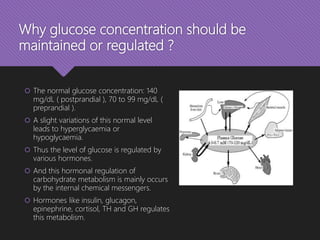
Glucoregulation is the maintenance of steady levels of glucose in the body toàn thân.
Hormones released
from the pancreas regulate the overall metabolism of glucose.[17] Insulin and glucagon are the primary hormones
involved in maintaining a steady level of glucose in the blood, and the release of each is controlled by the amount of nutrients currently available.[17] The amount of insulin released in the blood and sensitivity of the cells to the insulin both determine the amount of glucose that cells break
down.[4] Increased levels of glucagon activates the enzymes that catalyze glycogenolysis, and inhibits the enzymes that catalyze glycogenesis.[15] Conversely, glycogenesis is enhanced and glycogenolysis inhibited when there are high
levels of insulin in the blood.[15]
The level of circulatory glucose (known informally as “blood sugar”), as well as the detection of nutrients in the Duodenum is the most important factor determining the amount of glucagon or insulin produced. The release of glucagon is precipitated by low levels of blood glucose, whereas high levels of blood glucose
stimulates cells to produce insulin. Because the level of circulatory glucose is largely determined by the intake of dietary carbohydrates, diet controls major aspects of metabolism via insulin.[18] In humans, insulin is made by beta cells in the pancreas, fat is stored in
adipose tissue cells, and glycogen is both stored and released as needed by liver cells. Regardless of insulin levels, no glucose is released to the blood from internal glycogen stores from muscle cells.
Carbohydrates as
storage[edit]
Carbohydrates are typically stored as long polymers of glucose molecules with glycosidic bonds for structural tư vấn (e.g.
chitin, cellulose) or for energy storage (e.g. glycogen, starch). However, the strong affinity of most carbohydrates for water makes storage of large quantities
of carbohydrates inefficient due to the large molecular weight of the solvated water-carbohydrate complex. In most organisms, excess carbohydrates are regularly catabolised to form acetyl-CoA, which is a feed stock for the fatty acid synthesis pathway;
fatty acids, triglycerides, and other lipids are commonly used for long-term energy storage. The hydrophobic character of lipids makes them a much more compact form of energy storage than hydrophilic carbohydrates.
Gluconeogenesis permits glucose to be synthesized from various sources, including lipids.[19]
In some animals (such as
termites[20]) and some microorganisms (such as protists and bacteria), cellulose can be disassembled during digestion and
absorbed as glucose.[21]
Human diseases[edit]
Diabetes mellitus
Lactose intolerance
Fructose malabsorption
Galactosemia
Glycogen storage disease
References[edit]
^ a bcd efg hMaughan, Ron (2009). “Carbohydrate metabolism”. Surgery (Oxford). 27 (1): 6–10.
doi:10.1016/j.mpsur.2008.12.002.
^ abc def ghi jkl mno p.qr stNelson, David Lee (2013). Lehninger principles of biochemistry. Cox, Michael M., Lehninger, Albert L. (6th ed.). Thành Phố New York: W.H. Freeman and Company.
ISBN 978-1429234146. OCLC 824794893.
^ abcSanders, L. M. (năm nay). “Carbohydrate: Digestion, Absorption and Metabolism”.
Encyclopedia of Food and Health. pp. 643–650. doi:10.1016/b978-0-12-384947-2.00114-8. ISBN 9780123849533.
^ abc dHall, John E. (năm ngoái). Guyton and Hall Textbook of Medical Physiology E-Book (13 ed.). Elsevier Health Sciences. ISBN 978-0323389303.
^“Regulation of Cellular Respiration (Article).” Khan Academy. www.khanacademy.org,
^Nelson DL, Cox MM (2000). Lehninger Principles of Biochemistry. USA: Worth Publishers. p.. 724.
ISBN 978-1-57259-153-0.
^Silva P. “The Chemical Logic Behind Gluconeogenesis”. Archived from the original on August 26, 2009. Retrieved September 8, 2009.
^Beitz DC (2004). “Carbohydrate metabolism.”. In Reese WO (ed.). Dukes’ Physiology of Domestic Animals (12th ed.). Cornell Univ. Press. pp. 501–15. ISBN 978-0801442384.
^Kaleta C, de Figueiredo LF, Werner S, Guthke R, Ristow M, Schuster S (July 2011). “In silico evidence for gluconeogenesis from fatty acids in humans”. PLOS Computational
^Swe MT, Pongchaidecha A, Chatsudthipong V, Chattipakorn N, Lungkaphin A (June 2019). “Molecular signaling mechanisms of renal gluconeogenesis in nondiabetic and diabetic conditions”. Journal of Cellular Physiology. 234 (6): 8134–8151.
doi:10.1002/jcp.27598. PMID 30370538.
S2CID 53097552.
^Rodwell V (năm ngoái). Harper’s illustrated Biochemistry, 30th edition. USA: McGraw Hill. p.. 193. ISBN 978-0-07-182537-5.
^ abc dAhern, Kevin; Rajagopal, Indira; Tan, Taralyn (2017). Biochemistry Free for All. Oregon State
University.
^ abEnergetics of Cellular Respiration (Glucose Metabolism).
^ abLebovitz, Harold E. (năm nay). “Hyperglycemia Secondary to Nondiabetic Conditions and Therapies”. Endocrinology: Adult and Pediatric. pp. 737–51.
doi:10.1016/b978-0-323-18907-1.00042-1. ISBN 9780323189071.
^Brockman, R P (March 1978). “Roles of glucagon and insulin in the regulation of metabolism in ruminants. A review”. The Canadian Veterinary Journal. 19 (3): 55–62.
ISSN 0008-5286. PMC 1789349.
PMID 647618.
^G Cooper, The Cell, American Society of Microbiology, p.. 72
^Watanabe, Hirofumi; Hiroaki Noda; Gaku Tokuda; Nathan Lo (23
July 1998). “A cellulase gene of termite origin”. Nature. 394 (6691): 330–31. Bibcode:1998Natur.394..330W.
doi:10.1038/28527. PMID 9690469.
S2CID 4384555.
^Coleman, Geoffrey (8 February 1978). “The Metabolism of Cellulose, Glucose, and Starch by the Rumen Ciliate Protozoon Eudiplodinium Magii”. Journal of General Microbiology. 107 (2): 359–66.
doi:10.1099/00221287-107-2-359.
External links[edit]
Carbohydrate+metabolism at the US National Library of Medicine
Medical Subject Headings (MeSH)
BBC – GCSE Bitesize – Biology | Humans | Glucoregulation
Sugar4Kids
What are the 3 hormones control the carbohydrate metabolism?
And its secretion is regulated by 2 hypothalamic hormones and one stomach hormone i.e. growth hormone releasing hormone (GHRH), somatostatin and ghrelin. concentration also fatty acid and glycerol concentration in the blood. It decreases or inhibits the glucose uptake by the adipose tissue and skeletal muscle.
Which hormones are not involved in carbohydrate metabolism?
Which one of the following hormones is not involved in sugar metabolism? (1) Glucagon (2) Cortisone (3) Aldosterone (4) Insulin – India Site. Correct option: Aldosterone is not involved in sugar metabolism.
Which steroid hormones is involved in carbohydrate metabolism?
The final answer: A steroid hormone that regulates glucose metabolism is Cortisol.
Is growth hormone involved in carbohydrate metabolism?
It also stimulates amino acid uptake and protein synthesis in muscle and other tissues. Growth hormone has important effects on protein, lipid and carbohydrate metabolism.
Tải thêm tài liệu tương quan đến nội dung bài viết What hormones are involved in carbohydrate metabolism?
đoạn Clip What hormones are involved in carbohydrate metabolism? ?
Một số hướng dẫn một cách rõ ràng hơn về Review What hormones are involved in carbohydrate metabolism? tiên tiến và phát triển nhất .
Chia SẻLink Download What hormones are involved in carbohydrate metabolism? miễn phí
Bạn đang tìm một số trong những Share Link Down What hormones are involved in carbohydrate metabolism? miễn phí.